

Case summary
Nine experienced hikers cut their tent open from the inside at night on the slope of Kholat Syakhl and were later found dead with hypothermia and severe trauma. The 1959 Soviet inquiry closed the file citing an 'unknown compelling force'; in 2020 the Russian Prosecutor General formalised a delayed slab-avalanche explanation, which remains disputed among specialists.
Timeline
- 1959-01-27The group led by Igor Dyatlov set out from Vizhay.
- 1959-02-01Camp was pitched on the Kholat Syakhl slope; the last photographs date from this evening.
- 1959-02-26Searchers found the tent cut open from the inside and abandoned.
- 1959-02-27The first five bodies were found at the treeline and on the slope.
- 1959-05-04The remaining four bodies were recovered from a snow-filled ravine with severe trauma.
- 1959-05-28The inquiry was closed citing an 'unknown natural force' and the file was classified.
- 2020-07-11The Russian Prosecutor General announced a slab-avalanche conclusion after re-examination.
- 2021-01-28Gaume and Puzrin's numerical avalanche model was published in Communications Earth & Environment.
People and connections
- Igor Dyatlov
Expedition leader; Ural Polytechnical Institute student.
- Kholat Syakhl
'Dead Mountain' in Mansi; the slope where camp was pitched.
- Lev Ivanov
Prosecutor who led the 1959 inquiry and wrote the closing report.
- Gaume & Puzrin (2021)
The 2021 slab-avalanche simulation attempting to explain the trauma pattern.
- Igor Dyatlov to Kholat SyakhlCamp position on the night of 1 February
- Lev Ivanov to Gaume & Puzrin (2021)The 1959 closing report and the 2021 model read the same evidence differently
Findings
The tent was cut open from the inside and abandoned; all nine died away from camp.
Six deaths were attributed to hypothermia and three to severe chest or skull trauma.
A delayed slab avalanche could account for the trauma pattern and the abandonment of the tent.
The objection that the slope was too gentle for an avalanche remains in tension with the 2020–2021 model.
Claims of infrasound weapons, missile tests or covert military activity are not supported by primary documents.
Documents
- PhotographFinal roll of expedition filmFrames showing the tent being pitched on 1 February, preserved in the case file.
- Document1959 closing resolutionThe resolution containing the 'unknown compelling force' wording.
- MapSearch-area sketchOriginal sketch marking the tent, body positions and the cedar tree.
Sources
Locations
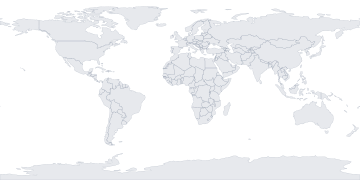
- Camp site (Kholat Syakhl slope)61.76°, 59.46°
- Vizhay (last settlement)61.15°, 60.05°
Researcher's note
Interpretation: the strength of this file is that the 1959 primary documents (autopsies, sketches, photographs) are now openly available as scans. The avalanche model is physically consistent, but a model demonstrates possibility, not independent confirmation from the scene. No exotic explanation has ever cleared the evidence threshold.
Recent checks
- 2026-05-18Source links checked; the scanned case-file archive remains reachable.
- 2026-02-03Critique literature on the 2021 model paper folded into findings.