
Internet records
Chapter 11 / 18
Name, address and DNS
A domain is a name. An IP is a network address. Neither is a person’s name.
Read DNS answers
A gives IPv4. AAAA gives IPv6. MX shows the mail route. One NS provider may serve many customers. CAA says which CA may issue a certificate. SRV gives service location. SOA carries zone information. Keep the time of each answer.
How big is a block?
IPv4 uses 32 bits. For /24, 32 − 24 leaves 8 bits. 2⁸ gives 256 total addresses. This is not a usable-host count. 192.0.2.0/24 is an example range. IPv6 uses 128 bits; 2001:db8::/32 is for examples. Separate private and publicly reachable addresses.
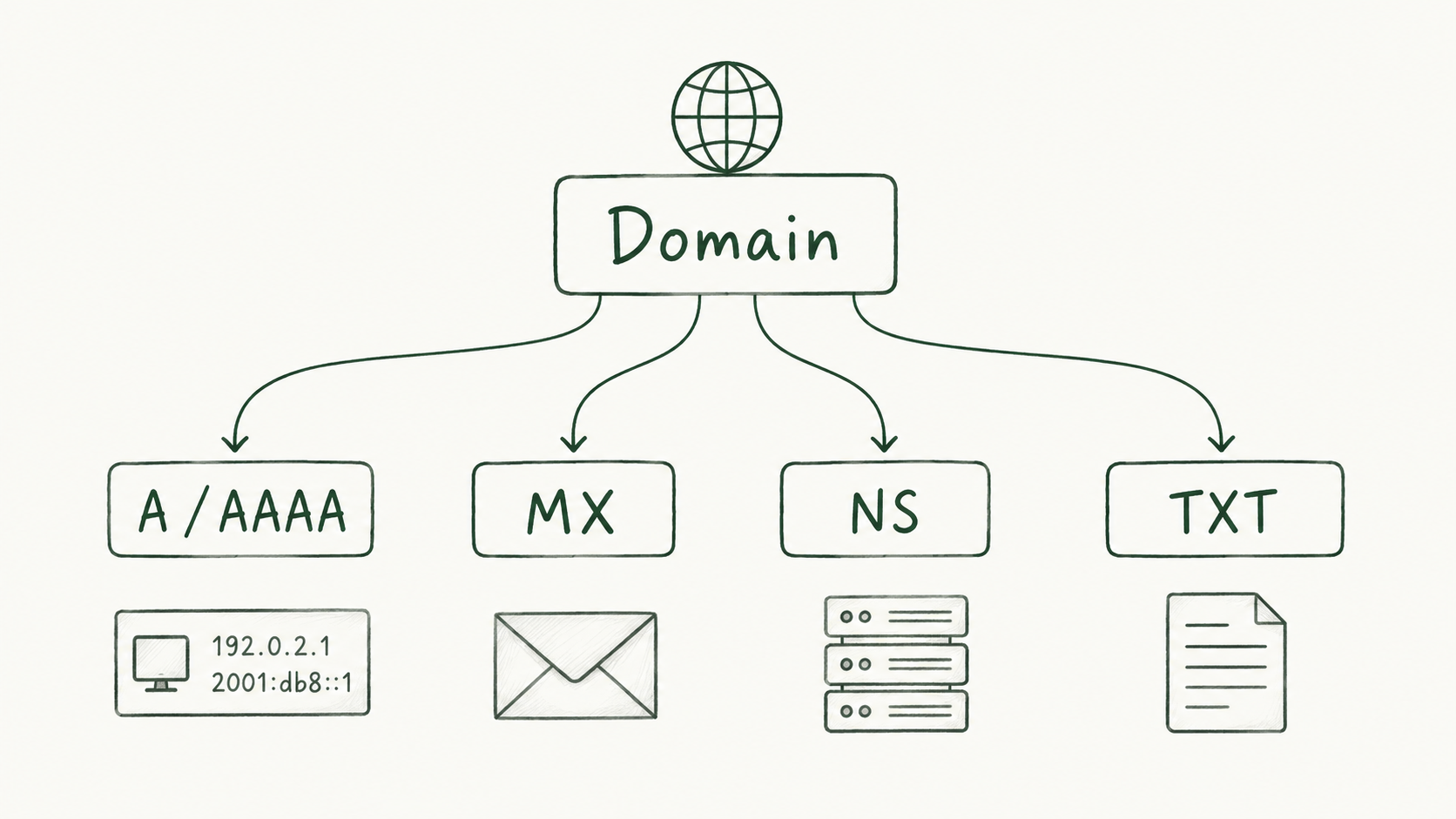
The DNS record family
 Enlarge ↗
Read as text
- A / AAAA → IP
- MX → Mail
- NS → DNS server
- TXT → Text
Same terms in both languages
Keep these words
- A / AAAA
- DNS records linking a name to IPv4 / IPv6.
- MX / NS
- Mail server / authoritative DNS server records.
- CNAME / PTR
- An alias to another name / a reverse IP-to-name record.
- TXT / TTL
- A text record / how long a DNS answer may be cached.
- CIDR / ASN
- Address-block notation / a routing network number.
A small example
Let’s do it together
Two sites have the same NS record. You do not know if one company owns both.
Write the record type, value, source and time.
Check whether a shared DNS provider explains it.
Passive DNS holds old observations. A live DNS query may reach target infrastructure; check permission and scope.
Close the notes. Think first.
Your turn
Which holds more total IPv4 addresses: /25 or /24?
Read the explanation
/24. It has 256 addresses; /25 has 128. A smaller prefix number gives a larger block.
Reading record
Only on this browser. These marks are not test results.Sources
I used my study notes and wrote new practice examples. The source PDF is not distributed here.
About the sources and rights