
Finish the work
Chapter 15 / 18
Privacy and keys
Hiding a connection and making a file safe are different jobs.
What does Tor not do?
An onion connection stays inside Tor; it does not use a public-internet exit relay. A harmful file is still harmful. A personal login can reveal identity. This book has no live onion browsing task. Set permission, scope and a stop limit first.
PGP: whose key?
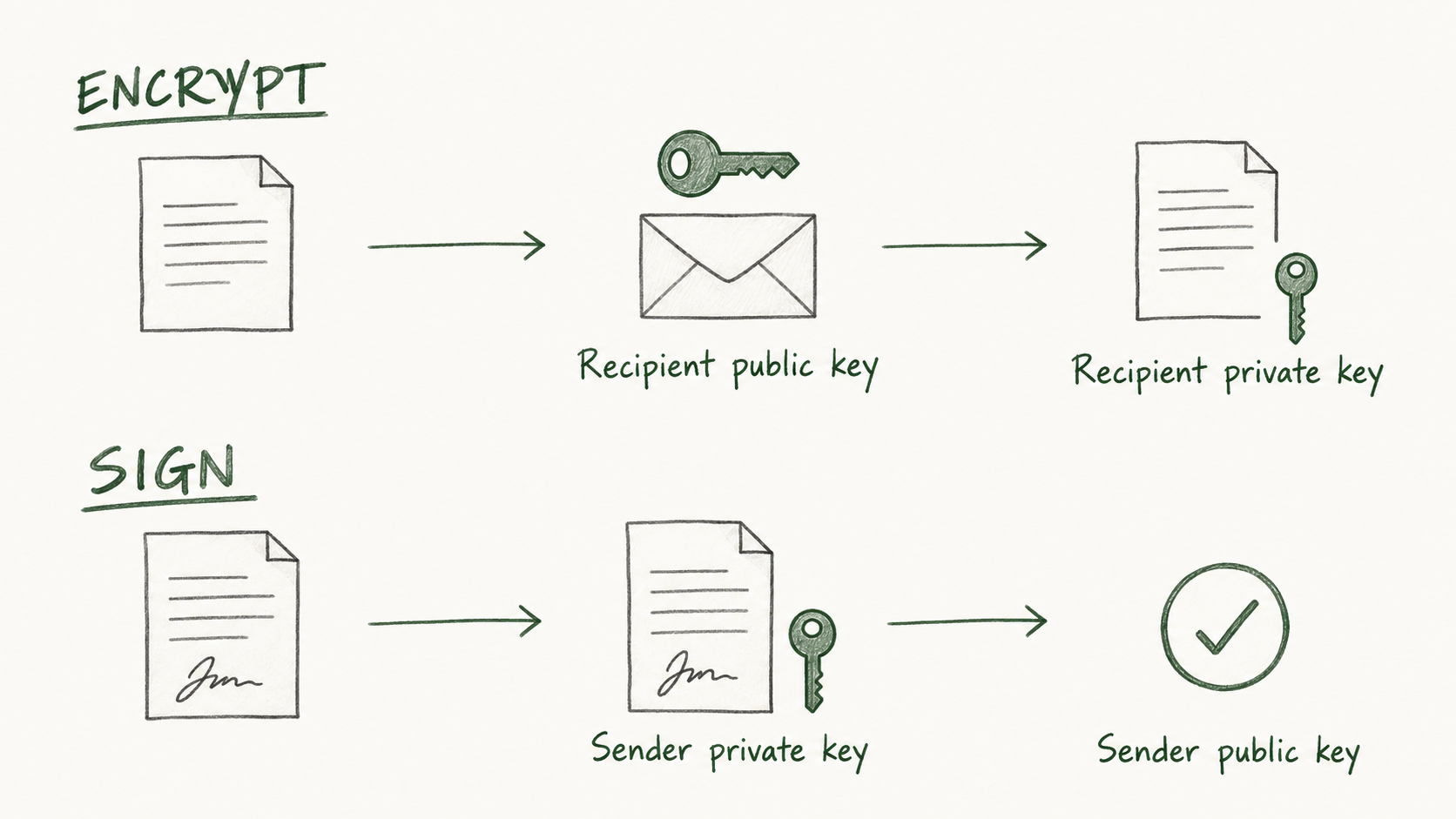
Encrypt for a recipient with the recipient’s public key. The recipient decrypts with their private key. A sender signs with their private key. A reader checks with the sender’s public key. A signature alone does not hide the message. Check the fingerprint through a separate trusted channel.
Two separate key jobs
 Enlarge ↗
Read as text
- Encrypt: recipient’s public → private key
- Sign: sender’s private → public key
Same terms in both languages
Keep these words
- Surface web / Deep web
- Indexed pages / content outside a search index.
- Dark web / Onion service
- Services on special networks / a service inside Tor.
- Public key / Private key
- A key you can share / a key you keep secret.
- Key fingerprint
- A value used to identify a particular key.
A small example
Let’s do it together
In this made-up example, Ece sends Deniz a private note. We use no real keys or messages.
Ece checks Deniz’s public key and fingerprint.
Ece encrypts the note with Deniz’s public key.
Deniz decrypts with their private key and keeps that key secret.
Close the notes. Think first.
Your turn
A leak post says data was stolen from a company. Is the breach confirmed?
Read the explanation
No. There is a claim. Check the source, date, company match and independent support. Do not buy stolen data or collect unneeded data just to check.
Reading record
Only on this browser. These marks are not test results.Sources
I used my study notes and wrote new practice examples. The source PDF is not distributed here.
About the sources and rights